What Has Been Tried and What Needs to Be Done
Over the years, Ghana has launched a number of initiatives aimed at industrialisation, agricultural transformation and regional development. Many of these efforts have recognised the need to process more of what the country produces, create jobs closer to rural communities and reduce dependence on raw commodity exports.
This direction is important. But in the Northern Savannah, the question is no longer whether value addition matters. The real question is whether the models used so far have been designed to build resilient, integrated rural economies.
At Mamuci, the view is that important groundwork has been laid, but too much of what has been tried remains fragmented, linear and disconnected from the wider landscape. The next phase must move beyond isolated projects toward circular agro-industrial hubs that connect production, processing, restoration and community wealth creation in one system.
What Has Been Tried
Ghana has not lacked ambition. Over the last decade, various public programmes and investment frameworks have sought to stimulate agro-processing, rural enterprise and district-level industrial activity. These interventions have helped put industrialisation back at the centre of national development thinking.
They have also helped establish a stronger case for local processing, regional investment and job creation outside the largest cities. In many places, they have created useful assets, attracted attention to under-served regions and opened space for new private investment.
Yet many of these initiatives have followed a familiar pattern. A factory is planned around a single commodity. Infrastructure is considered mainly at the plant level. Feedstock is treated as a supply problem rather than a landscape system. Waste is rarely designed into a second productive use. Community participation is often narrow, and long-term ecological restoration remains peripheral rather than central.
The result is that even promising projects can struggle to deliver lasting transformation. They may process raw materials, but they do not necessarily build integrated local economies. They may create activity, but not always resilient systems. They may bring industry closer to the Savannah, but not always in a way that keeps value cycling within it.
The Limits of Standalone Thinking
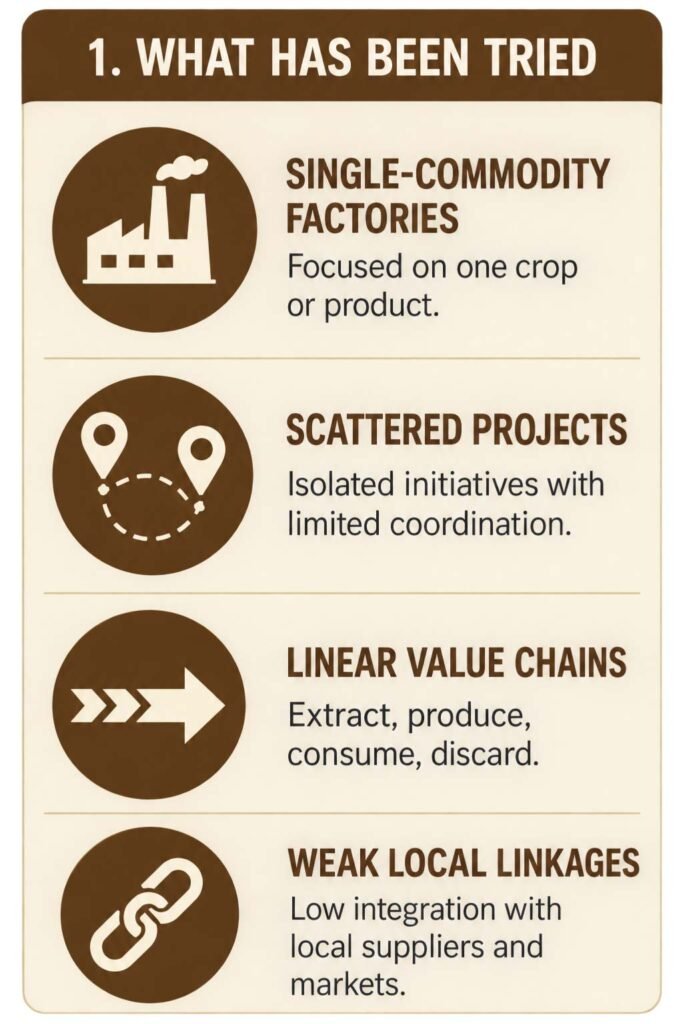
A major weakness in earlier approaches is the tendency to think in units rather than systems. One plant, one commodity, one district, one intervention. This can be useful for mobilisation, but it is rarely enough for durable regional transformation.
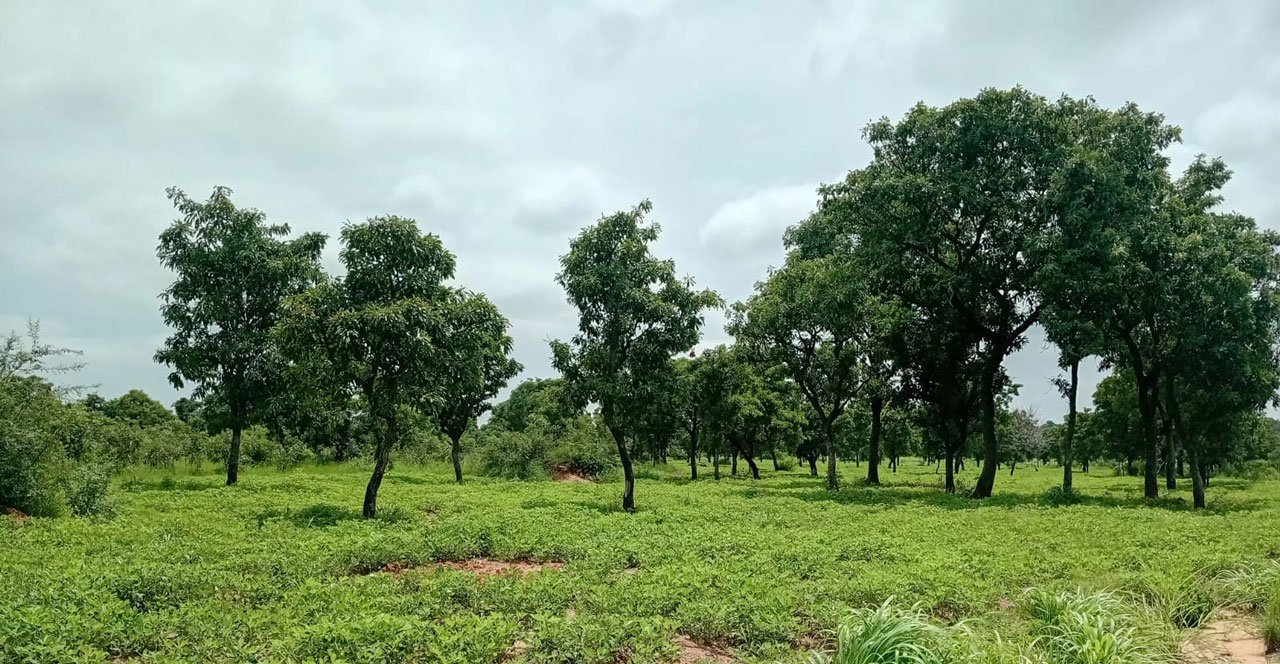
The Northern Savannah is not simply a place where raw materials are produced and then collected for processing. It is a living production landscape shaped by rainfall uncertainty, degraded soils, dispersed producers, customary land systems, weak logistics and high poverty. Any serious agro-industrial strategy for the region must be designed around those realities.
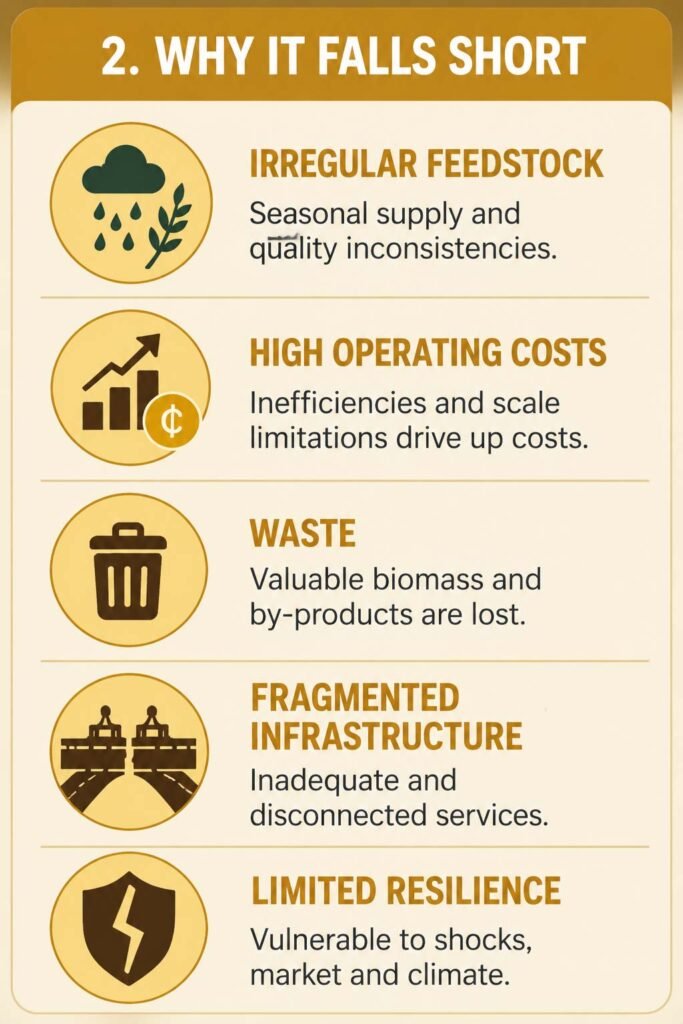
Standalone projects often face the same recurring constraints: irregular feedstock flows, high operating costs, limited working capital, weak storage, unreliable energy, narrow market channels and little capacity to use by-products productively. When one part of the chain underperforms, the entire venture becomes vulnerable.
This is why Mamuci sees circular integration not as an environmental add-on, but as an economic necessity.
What Needs to Change
The next step is to replace fragmented agro-industrial thinking with integrated circular systems.
This means designing hubs where multiple value chains can operate together and support one another. Grains, shea, timber, livestock, oilseeds and other activities should not be planned in isolation if they share land, labour, water, biomass, transport systems and market infrastructure.
It also means treating by-products as assets rather than waste. Husks, shells, manure, sawdust, fruit waste and organic effluent should be captured and redirected into energy, compost, biochar, bio-fertilisers and other productive uses. This reduces waste management costs, creates additional revenue streams and strengthens the regenerative capacity of the surrounding landscape.
Most importantly, future hubs must be anchored in the communities around them. Farmers, women’s groups, youth enterprises and local service providers should not sit at the edge of industrial development. They should be built into its ownership, supply systems, workforce and long-term value creation.
The Role of the Private Sector
Mamuci believes the private sector has a critical role to play in this next phase, not because public policy is unimportant, but because integrated hubs require commercial discipline, operational agility and long-term execution.
National programmes can set direction, provide enabling infrastructure and reduce early-stage risk. But it is often private operators who must solve the day-to-day realities of feedstock planning, technical performance, logistics, quality control, customer development and circular resource use.
A strong private-sector-led model is better placed to design around viability from the beginning. It can test combinations of processing, energy recovery, biomass utilisation, storage and restoration until the model works in practice. It can also adapt faster when conditions change.
For the Savannah, this matters. Transformation will not come from announcing more facilities alone. It will come from operating systems that can survive seasonality, absorb shocks, create value from waste and generate returns while restoring the landscape that sustains them.
The Enabling Conditions
If circular agro-industrial hubs are to succeed in the Savannah, four enabling conditions must be taken seriously.
First, finance must be structured for systems, not just structures. Capital is needed not only for processing equipment but also for shared infrastructure, working capital, storage, drying, biomass conversion, land restoration and community integration. Short-term project finance alone is rarely enough.
Second, land tenure must be approached carefully and honestly. In the Savannah, industrial development sits within landscapes shaped by customary authority, family rights and long-standing local relationships. A viable hub model must secure land access in ways that are transparent, legitimate and compatible with community trust.
Third, operational capacity is essential. Integrated hubs require more than machines. They require management systems, technical know-how, maintenance culture, logistics coordination and the ability to run several connected value streams at once.
Fourth, national policy must do more than encourage industrialisation in general terms. It should actively support circular design, shared infrastructure, regional clustering, biomass utilisation, regenerative land use and long-term private investment in the Savannah.
Mamuci’s View of the Next Phase
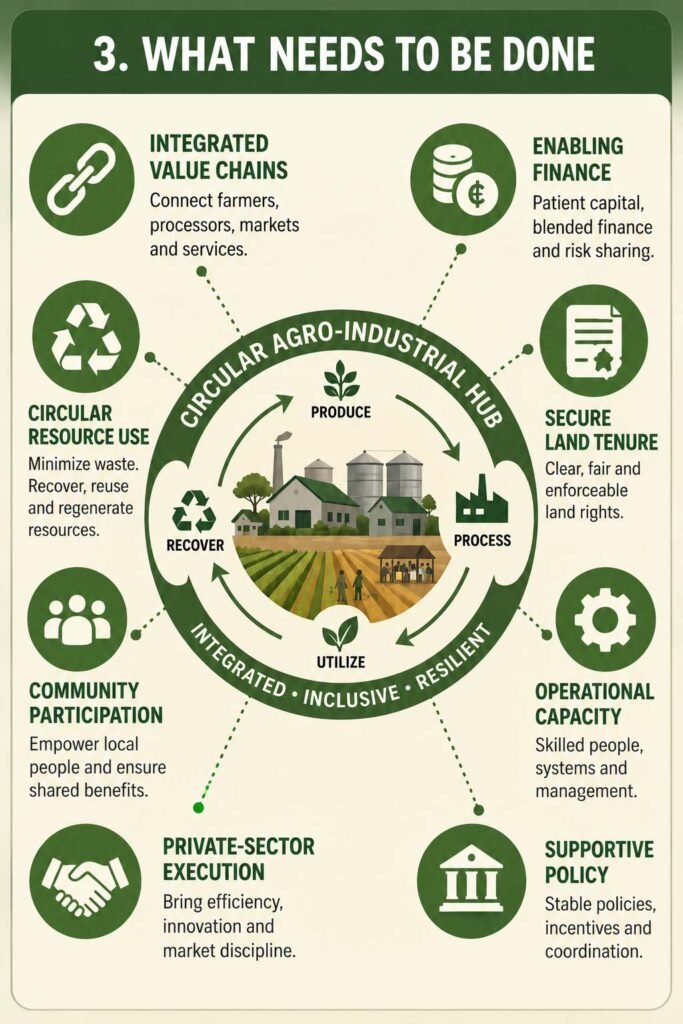
At Mamuci, the path forward is clear. The Savannah does not need more disconnected projects competing for the same limited infrastructure and seasonal raw materials. It needs well-designed, place-based systems that combine production, processing, restoration and community participation in a coherent whole.
That is the promise of circular agro-industrial hubs. They move beyond linear extraction. They reduce waste. They strengthen local enterprise. They improve the commercial logic of value addition. And they create the conditions for rural wealth to remain in the landscape that generates it.
What has been tried so far has helped open the door. What needs to be done now is to walk through it with a more integrated model – one that is commercially grounded, ecologically intelligent and built for the long term.